


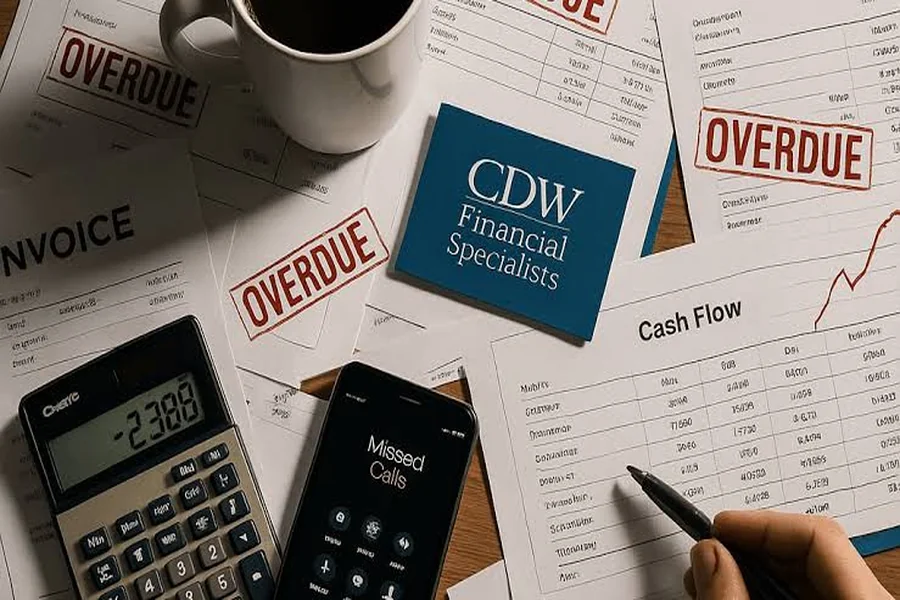
There’s a kind of mental overhead that comes with running a business that’s perpetually short on cash. It’s not always visible in the numbers — the business might be profitable, the pipeline might be full — but it’s present in every decision, every week. Should we hire? Can we afford this software? What if that invoice doesn’t come in on time? This cognitive burden is the hidden productivity tax of poor cash flow, and it’s one of the most underappreciated costs of running a business on a tight working capital cushion.
How Financial Stress Affects Decision-Making
Research in behavioural economics has consistently found that financial scarcity — the feeling of not having enough — narrows cognitive bandwidth in ways that impair decision-making quality. When attention is partly consumed by cash flow anxiety, there’s less available for strategic thinking, creative problem-solving, and the longer-range planning that drives business growth.
For business owners, this shows up in predictable ways: a reluctance to invest in growth opportunities because of uncertainty about next month’s cash position, a tendency to make reactive rather than proactive decisions, and a focus on short-term survival at the expense of medium-term development. According to Harvard Business Review, the cognitive cost of financial scarcity is well-documented and affects both individuals and organisations in structural ways.
The Receivables Gap Is Often the Culprit
The interesting thing about this kind of cash flow anxiety in otherwise healthy businesses is that it’s usually not caused by insufficient revenue. It’s caused by the gap between when revenue is earned and when it’s collected. A business that generates strong monthly invoices but collects on 60-day terms is, in effect, running two months behind its own financial reality at all times.
That gap is the source of the anxiety. And because it’s structural — built into the payment terms of key client relationships — it doesn’t resolve itself through harder work, better sales, or tighter budgeting. It requires a direct intervention in the timing of cash collection.
What Predictable Cash Flow Actually Enables
When the gap between invoicing and collecting is closed — either through faster payment, better collections practices, or by financing against outstanding invoices — something notable happens to decision-making quality. The question stops being “can we afford this?” and becomes “is this the best use of available capital?” That’s a different question, and it produces better answers.
Businesses with predictable cash flow invest more consistently in growth activities. They hire ahead of demand rather than behind it. They take on larger clients and contracts without being constrained by whether the last invoice has cleared. They negotiate better supplier terms because they can pay promptly. The compounding effect of these better decisions over time is what separates businesses that grow steadily from ones that stall despite strong underlying demand.
Addressing the Structural Gap
For businesses where the cash flow gap is driven by outstanding receivables — invoices raised but not yet paid — one of the most direct tools available is invoice financing. Rather than waiting out a customer’s 30, 45, or 60-day payment cycle, a business can advance against the value of those invoices and convert earned revenue into usable cash within days.
Platforms like Invoice Interchange offer this through a marketplace model, where businesses with outstanding invoices are connected with funders willing to advance against them. The credit assessment is based primarily on the paying customer’s quality rather than the business’s own balance sheet, which makes it accessible even to younger or fast-growing businesses that might not qualify for a conventional credit facility.
The Productivity Case for Better Cash Flow Tools
Most discussions of invoice financing focus on the financial mechanics — advance rates, fees, collection processes. These matter, but they’re not the whole picture. The less-quantified benefit is the cognitive one: the removal of the constant low-level anxiety that comes from not knowing whether this month’s cash will cover next month’s obligations.
Business owners who have fixed their cash flow gap consistently describe making better decisions afterward — not because their financial situation changed dramatically, but because the mental space that was previously occupied by cash flow management became available for other things. That’s a productivity gain that doesn’t show up on any income statement, but it’s real and it compounds.
Where to Start
The starting point is clarity: how large is the gap between outstanding receivables and upcoming obligations, and is it getting bigger or smaller over time? Once the size and direction of the gap is understood, the right tool — whether that’s tighter collections, better payment term negotiation, or invoice financing — becomes easier to identify. The mistake is to keep absorbing the cost of the gap without addressing it, on the assumption that it will resolve itself once the business gets a bit bigger. For most businesses, it doesn’t. It grows with them.

1 Comment
Pingback: How CPAs Provide Assurance in Public Company Filings