



You sit in the dental chair, the bib is on, and then comes that familiar moment when the assistant reaches for the X rays at the office of a dentist in Beaverton, OR. If you have ever wondered how much they show, how long they take, or whether they are really needed, you are not alone. A lot of people feel a little tense at this part of the visit, especially if they are already dealing with tooth pain, cost concerns, or a problem that has dragged on longer than it should.
That tension makes sense. Dental care feels harder when answers are vague or delayed. You want your dentist to spot problems early, explain them clearly, and avoid wasting your time. That is where digital imaging has changed the experience. Why Digital X Rays Are Transforming General Dentistry comes down to a few plain facts. They create faster images, support earlier diagnosis, reduce retakes in many cases, and help your dentist show you what is happening in your mouth with more clarity.
Digital dental X rays make hidden problems easier to catch
Many dental problems do not announce themselves right away. A cavity can grow between teeth with no obvious pain. Bone loss from gum disease can start quietly. An infection can sit beneath the surface until it becomes an emergency. If you have ever been told, “We caught this just in time,” you know how much depends on seeing what is not visible during a basic exam.
Digital dental radiography gives dentists a clearer way to detect those issues early. The images appear on a screen within seconds, and they can often be enlarged or adjusted for contrast. That matters because small changes can signal the start of a larger problem. A tiny area of decay is easier to treat than a tooth that now needs a root canal or extraction.
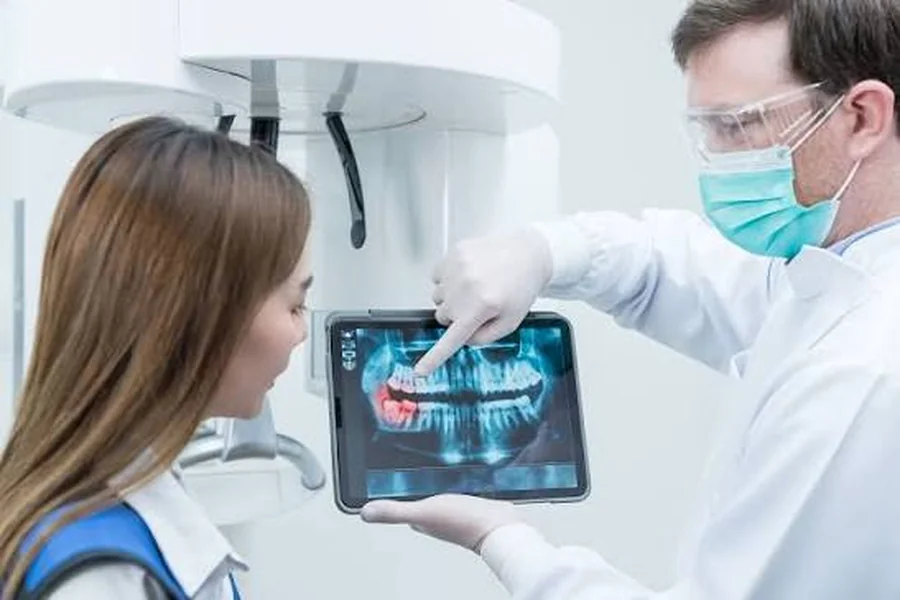
Speed also changes the feel of the visit. Instead of waiting for film to be processed, your dentist can review the image with you right away. You are not left wondering what comes next. You can look at the same screen, hear a plain explanation, and understand why a treatment is or is not needed.
Digital X rays in dentistry support safer, more precise care
Radiation is a fair concern, and patients should feel comfortable asking about it. The good news is that modern dental imaging is used with clear guidance. The FDA explains that dental radiographs should be selected based on a patient’s needs, age, risk factors, and signs of disease, not taken on a fixed schedule for everyone. You can review the agency’s guidance on the selection of patients for dental radiographic examinations.
That individualized approach matters. If you get frequent cavities, have gum disease, or need work checked, imaging may be more useful than it would be for someone with a lower risk profile. The point is not more X rays. The point is the right X rays at the right time.
General dentistry has also benefited from the way digital systems connect with broader advances in care. Data tools, digital records, and imaging can work together to improve diagnosis and treatment planning. The National Institute of Dental and Craniofacial Research highlights how these tools can improve care quality and decision making in its overview of data science and digital dentistry.
For patients, that often means fewer surprises. A dentist can compare current and past images more easily, track changes over time, and explain why a watch area now needs treatment or why it can safely wait.
Digital imaging helps prevent bigger costs and more invasive treatment
Most people do not worry about a tiny cavity. They worry about what happens if that cavity turns into a crown, a root canal, or a missing tooth. Delayed diagnosis gets expensive fast. It also gets stressful. Pain rarely shows up at a convenient time, and emergency dental work tends to arrive with extra cost, missed work, and a bigger recovery.
This is one reason digital X rays matter so much in a general dentist office. They support early intervention. When a problem is found sooner, treatment is often simpler, shorter, and less expensive. That does not mean every shadow on an image leads to treatment. It means your dentist has better information to make a careful call.
| Feature | Digital X Rays | Traditional Film X Rays |
| Image availability | Appears within seconds | Requires processing time |
| Image review | Can often be enlarged and adjusted on screen | Limited adjustment after capture |
| Communication with patients | Easy to display and discuss chairside | Less immediate and less flexible |
| Record storage | Simple digital storage and comparison over time | Physical storage and slower retrieval |
| Retakes | May be reduced with instant image review | Problems may be discovered after processing |
Practical steps to take before your next dental X ray
Ask why the images are recommended. You deserve a clear answer. A good explanation is specific. It may be to check for decay between teeth, monitor bone levels, evaluate pain, or review a treatment area. If the reason is tied to your symptoms or history, the decision will feel more grounded and less routine.
Tell your dentist about changes in your health and dental history. New pain, pregnancy, recent treatment, dry mouth, frequent cavities, and gum problems all affect imaging decisions. The more complete the picture, the more tailored your care can be.
Ask to see the images. This is one of the simplest ways to feel more in control. When your dentist points to the area of concern on the screen, the conversation gets easier. You are not being told to trust a mystery. You are being shown what they see and why it matters.
Digital X rays are changing the everyday dental visit for the better
If dental visits have ever felt rushed, unclear, or reactive, digital imaging helps shift that pattern. It supports quicker answers, earlier detection, and better conversations between you and your dentist. That is the real change. The technology is useful because it makes care more understandable and often more timely.
If you are due for a checkup or have a concern that has been lingering, schedule a visit with a general dentist and ask how digital X rays fit into your care. A clearer picture now can spare you a harder problem later.
