



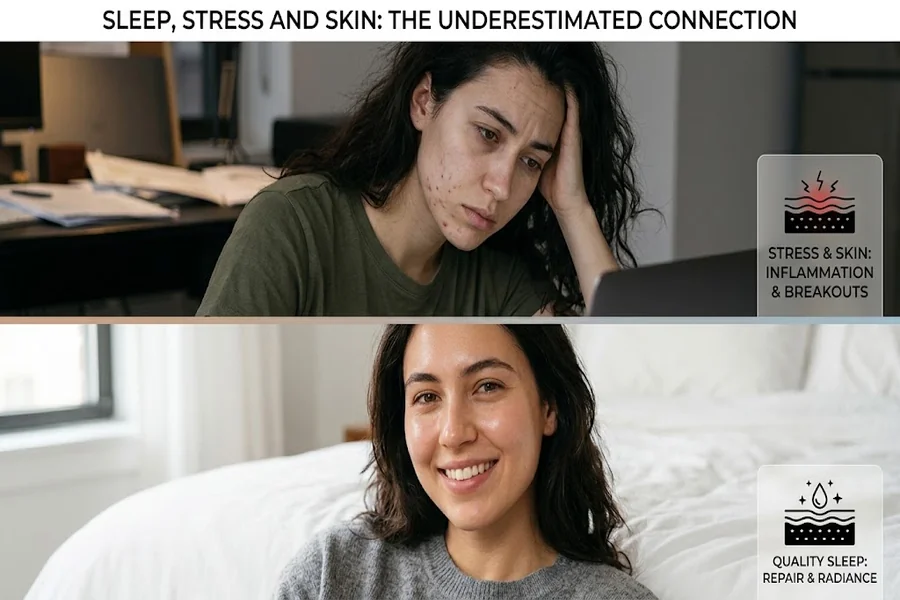
Ask most people what affects their skin and you’ll hear about products, diet and genetics. Sleep and stress usually come up late, framed as vaguely relevant rather than central.
The physiological evidence suggests that ordering is backwards.
What happens to skin during sleep
Skin repair is not evenly distributed across the day. Cell turnover, collagen synthesis and barrier restoration all peak during sleep, particularly during deep sleep stages in the first half of the night.
Blood flow to the skin increases overnight. Growth hormone, which drives tissue repair, is released predominantly during deep sleep. Transepidermal water loss also peaks at night, which is why the skin is more receptive to occlusive products before bed — and more vulnerable to dehydration if the barrier is compromised.
Cut sleep short and you truncate this process. A single poor night is recoverable. Chronic restriction is where visible effects accumulate.
Research on sleep-deprived participants has consistently found measurable differences in skin barrier function, recovery from stressors, and observer ratings of appearance. These aren’t subtle self-report effects — they show up in instrument measurements.
The cortisol pathway
Stress affects skin primarily through cortisol, and the mechanisms are well documented.
Collagen breakdown. Elevated cortisol increases the activity of enzymes that degrade collagen while suppressing new collagen synthesis. Chronic stress therefore accelerates the same structural loss that occurs with ageing.
Barrier disruption. Cortisol impairs the production of barrier lipids. This is why stressed skin often becomes simultaneously dry and reactive — the protective layer is literally thinner.
Inflammation. Stress upregulates inflammatory signalling. For anyone with an inflammatory skin condition, this is the most immediately visible effect.
Sebum changes. Cortisol influences sebaceous gland activity, which is part of why stress-related breakouts are a genuine phenomenon rather than a coincidence.
The compounding problem
Sleep and stress interact. Stress disrupts sleep; poor sleep raises cortisol; elevated cortisol makes sleep harder. The loop is self-reinforcing, and skin sits downstream of all of it.
This is why periods of high stress often produce skin changes that seem disproportionate to any single factor. Multiple mechanisms are operating simultaneously.
What actually helps
Sleep consistency over sleep duration. Going to bed and waking at similar times matters more for sleep quality than total hours, within reason. Irregular schedules disrupt circadian regulation of the repair processes described above.
Address the barrier during high-stress periods. If you know a demanding period is coming, simplify the routine and prioritise barrier support rather than introducing new actives. Skin under cortisol load tolerates less.
Don’t overcorrect with products. The instinct when skin looks bad is to add treatments. During stress-related flares this frequently worsens things, because the underlying issue is systemic rather than topical.
Recognise the limits of skincare. No product compensates for four hours of sleep a night sustained over months. This is worth saying plainly, because a great deal of money is spent trying.
Where professional treatment fits
Professional treatments that stimulate collagen production can address structural changes that stress has accelerated — but they work best alongside addressing the cause rather than instead of it.
Clinics that assess properly will ask about sleep, stress and lifestyle before recommending anything. Beauty & Laser in Windsor, Ontario, structures consultations this way, on the reasoning that a treatment plan built without understanding what’s driving the concern is unlikely to produce lasting results.
That’s a reasonable standard to apply generally. If a clinic recommends a treatment protocol without asking anything about your life, the recommendation is about their menu rather than your skin.
